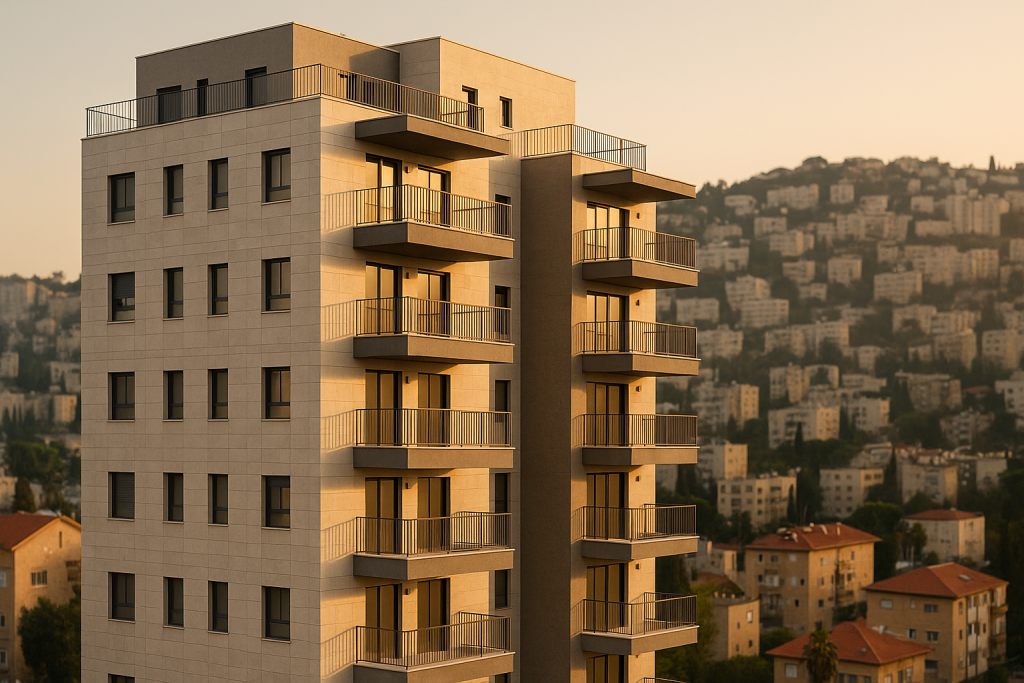
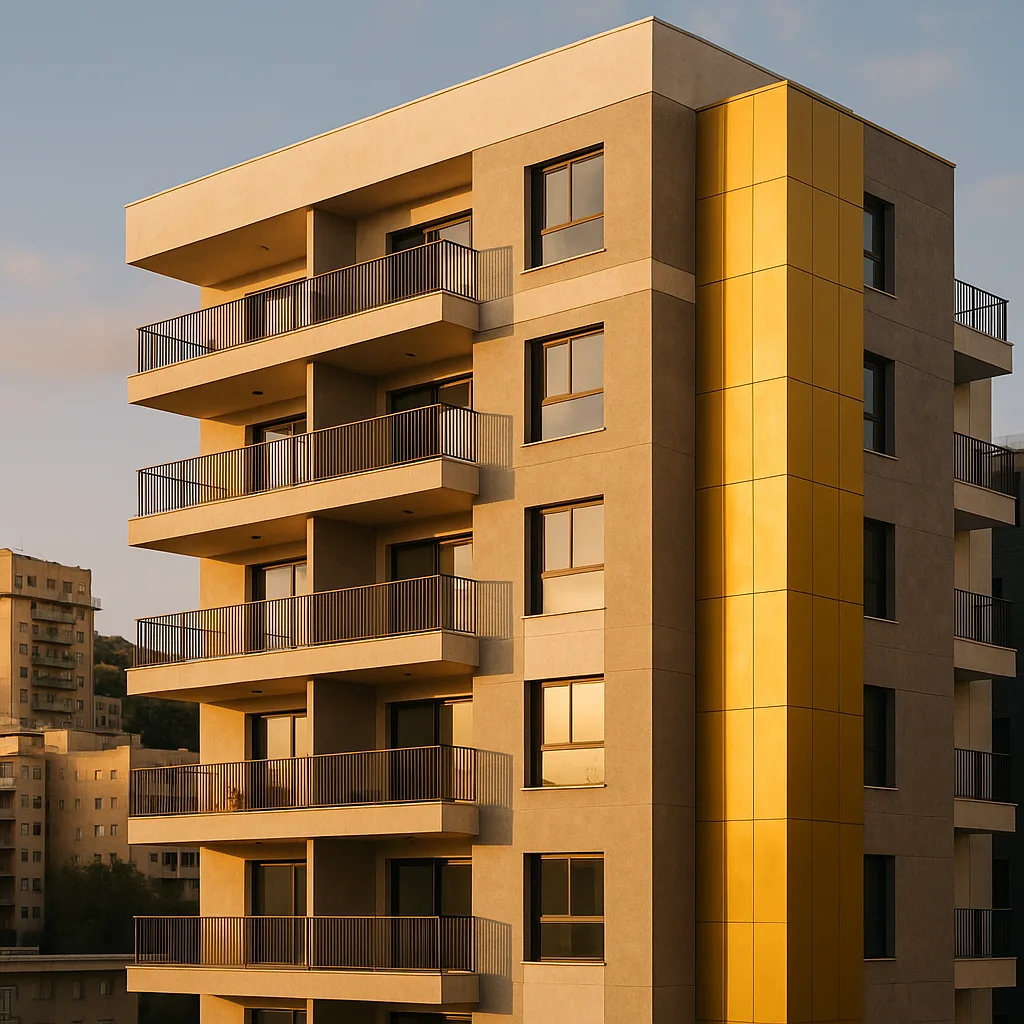
Evacuation-construction (Pinui-Binui) in Haifa is the planning process in which an old building (usually from the 1950s to the 1970s) is demolished and a new, large and modern compound is built in its place, while preserving the rights of the existing residents. According to the Government Authority for Urban Renewal, by the end of the first quarter of 2026, some 47 evacuation-construction compounds encompassing more than 18,000 housing units had been approved in Haifa, a figure that places the city third in the country. In this guide you will get everything a Haifa resident needs to know: what your rights are, what the exact stages are, who pays for what, and which mistakes 7 out of 10 residents fall into. At Ahuza Real Estate Haifa we have been guiding evacuation-construction projects for over 12 years, and we have gathered here the practical experience alongside the legal aspects, so that you arrive prepared for your next residents’ meeting.
Last updated: May 2026 | Reading time: 9 minutes | Based on a portfolio of 14 active projects in Haifa
Key facts about evacuation-construction in Haifa 2026
- 47 compounds approved by Q1/2026, 18,000+ housing units expected
- A resident is entitled to an apartment at least 25 sqm larger than the existing one (Haifa average: +32 sqm)
- 67% resident consent is required to advance under the Evacuation-Construction (Compensation) Law, not 100%
- Average project duration in Haifa: 5.5 years from first signing to handover
- The developer pays 100% of the costs, residents do not spend a shekel out of pocket
What evacuation-construction actually is, the legal definition
Evacuation-construction is an urban renewal track in which an existing building is fully demolished, and in its place a new building is constructed with significantly larger building volume, usually 3 to 5 times relative to the original. The process is anchored mainly in the Government Authority for Urban Renewal Law, 5776-2016 and the Evacuation-Construction (Compensation) Law, 5766-2006. Contrary to what many think, evacuation-construction is not merely an “upgrade of the building”, it is a full replacement of the asset, with the resident receiving a brand-new apartment in the new project.
The law defines three main categories: (1) compound evacuation-construction, a cluster of several buildings evacuated together; (2) plot evacuation-construction, for a single building; (3) construction-evacuation, a less common method in which the developer builds first and only then evacuates. In Haifa, most projects as of 2026 are of category (1), meaning compounds of 4–12 buildings, which allows a complete urban design of the surroundings including gardens, commercial space and new infrastructure.
Evacuation-construction vs TAMA 38, the practical difference
The most common mistake is confusing evacuation-construction with TAMA 38. Although both plans belong to the world of urban renewal, they differ substantially. In building renewal, the track that replaced TAMA 38 after it expired in October 2023, a single building is demolished and rebuilt on the same plot under a detailed plan approved by the local committee. In evacuation-construction, by contrast, this is a redesign of an entire compound, not just a single building.
| Parameter | Evacuation-Construction | Building renewal (formerly TAMA 38) |
|---|---|---|
| Scope | A compound of 2–15 buildings | A single building |
| Result | Completely new buildings | Reinforcement or demolition+construction |
| Addition per resident (Haifa average) | +32 sqm + protected room + parking + balcony | +12–25 sqm + protected room |
| Resident consent | 67% under the law | 66.67% (reinforcement) / 80% (demolition) |
| Duration A to Z | 5–7 years | 3–5 years |
| Suited to | Very old buildings in a wide compound | A single, legally stable building |
In Haifa specifically, most of the old compounds in Kiryat Eliezer, Upper Hadar and Bat Galim are suited to the evacuation-construction track thanks to the density of 4-story buildings that can be replaced with towers of 18–22 floors. For a deeper read on the shorter track, see our guide on TAMA 38 in Haifa, and for a full overview of all the urban renewal tracks in the city, the complete guide to urban renewal in Haifa.
Resident rights in evacuation-construction, what the law entitles you to
This is the section for which residents sign for less than their true value. Your rights are anchored in the law, not in the developer’s promises. Here is the full list:
- A larger new apartment: an addition of at least 25 sqm relative to the existing apartment. In Haifa the average is higher, between 28 and 38 sqm.
- A standard protected room (in addition to the 25 sqm): a fortified security room, mandatory under standard 4570.
- Private parking: at least one per housing unit. In new Haifa towers, two for 4+ room apartments.
- A sun balcony: 9 sqm and up (outside the 25 sqm core).
- A dedicated storage unit: 5–7 sqm at the basement level.
- Rent for the entire construction period: the Compensation Law requires the developer to fund an alternative apartment of the same quality level, in a reasonable location. In most of Haifa: ₪4,800–₪7,200 per month, index-linked.
- Moving and transport fees: a one-time payment of ₪4,000–₪9,000 (depending on apartment size).
- Tax exemption: full exemption from betterment tax, VAT and purchase tax on the original transaction, as well as exemption from municipal tax during the evacuation.
- An autonomous bank guarantee: the developer must deposit a guarantee covering the full value of the new apartment, as protection in case of bankruptcy.
- An internal veto right: the right to choose the floor, orientation and layout of the new apartment, according to seniority order and a lottery.
Stages of an evacuation-construction project, from the meeting to the key
An evacuation-construction project in Haifa takes on average 5.5 years from the first signing to the handover of the keys. Here are the stages, with the practical time span:
Stage 1: residents’ committee and defining the goal (months 0–3)
Establishing an active residents’ committee, mapping all apartment owners (including heirs and partners who do not live in the building), choosing an independent lawyer on behalf of the residents. Important: the lawyer must be separate from the developer’s lawyer. In Haifa it is customary for the developer to pay the fee of the residents’ lawyer, but the residents are the ones who choose them.
Stage 2: developer tender (months 3–9)
Publishing a closed or open tender, examining 3–5 developers, comparing economic terms, checking financial soundness, visiting sites the developer has completed. In the city of Haifa specifically, the number of active developers in the field is about 22 (as of Q1/2026), with 5 of them executing more than 70% of the projects.
Stage 3: signing the residents-developer agreement (months 9–12)
The most critical stage. The agreement includes everything noted in the rights section, guarantees, timelines, and penalties in case of delay. In Haifa the standard is a daily fine of ₪250–₪400 for a delay in handover.
Stage 4: planning and licensing (months 12–36)
Submitting a detailed zoning plan to the Haifa local committee, objections, approval by the district committee. This is the longest stage, usually taking 2–3 years. In Haifa, the Haifa District Committee approves evacuation-construction projects on average within 18–26 months of submission.
Stage 5: evacuation and construction (months 36–66)
The residents move to alternative apartments (fully funded by the developer), the existing structures are demolished and the new towers are built. The construction stage alone takes 24–30 months for a standard 18-story residential building in Haifa.
Stage 6: handover and occupancy (months 66–72)
Receiving Form 4, occupancy approval, handing over keys to returning residents and new buyers, registering a new condominium in the Land Registry.
67%, the Evacuation-Construction (Compensation) Law and what if a neighbor refuses
The most common question: “What if one neighbor doesn’t want to?” In the past, the consent of 100% of residents was required. The Evacuation-Construction (Compensation) Law of 2006, and a 2018 amendment, changed the picture. Today a refusing resident can be sued in the district court if they oppose a project supported by 67% of residents. If the court finds the objection unreasonable, the resident may be liable in damages toward the other residents.
For more information see the full entry on evacuation-construction (Wikipedia), as well as the municipal publications of the Haifa Municipality. In any case, it is advisable to consult an experienced real estate lawyer in Haifa before reaching a point of dispute.
Who pays for what, the full breakdown of costs
The golden rule: a resident does not pay, except for a few items. Here is the exact breakdown:
| Item | Who pays | Typical amount in Haifa 2026 |
|---|---|---|
| Architectural planning and consultants | The developer | ₪1.5–₪3 million |
| Residents’ lawyer | The developer | Half a percent of the project value |
| Residents’ appraiser | The developer | ₪30,000–₪65,000 |
| Alternative rent | The developer | ₪4,800–₪7,200/month |
| Betterment levy | The developer (resident exempt) | |
| Purchase tax on the new apartment | Exempt (the resident) | ₪0 |
| Maintenance management fees during construction | The developer | |
| Personal renovations in the new apartment | The resident | As chosen |
| Home insurance | The resident | ₪800–₪1,400/year |
Evacuation-construction in Haifa, the fastest-moving neighborhoods
Haifa is the third city in the country in the scope of evacuation-construction, after Tel Aviv and Bat Yam. According to the Haifa Municipality’s report for the first quarter of 2026, the neighborhoods leading the pace are:
- Kiryat Eliezer: 14 active compounds, 5,200 housing units planned. Plan HP/2666 allows construction to a height of up to 28 floors.
- Upper Hadar: 9 compounds, 3,400 housing units. An area with 60–70 year old buildings, ideal for evacuation-construction.
- Bat Galim: 6 compounds, 2,100 housing units. Proximity to the beach + the new Rambam hospital complex.
- Neve David: 5 compounds, 1,800 housing units. A veteran neighborhood near new public buildings.
- Neve Sha’anan: 4 compounds, 1,500 housing units. Mainly along the main streets.
- Kiryat Haim: 4 compounds, 1,200 housing units. Access to the train and the port is added value.
For investors, and not only residents, these neighborhoods are also the hottest hubs for buying before the project gets under way. For more information on attractive investment neighborhoods, see our guide on investment neighborhoods in Haifa 2026, and on financing options, financing for real estate investment in Haifa.
7 common resident mistakes in evacuation-construction, how to avoid them
- Signing the agreement without an independent residents’ appraiser. Don’t. Your appraiser verifies the value of the new apartment relative to the existing one.
- Blind trust in the local developer who “promised well.” Any promise not in the agreement is worth less than the paper it was written on.
- Neglecting the autonomous bank guarantee. Without a guarantee, residents have lost their savings when the developer went bankrupt. In Haifa there were 2 such cases in the past decade.
- Agreeing to rights without specifics in writing. “An apartment 25 sqm larger”, where? Which orientation? Which floor? Full details in a binding appendix.
- No timeline with penalties. If there is no daily fine, the developer can delay another 5 years with no consequences.
- Splitting the residents’ committees. If the residents are split, the developer plays one against the other. One united committee = real bargaining power.
- Delaying approval to join. A resident who objects until the end may find themselves a losing plaintiff in court, paying costs to the other residents.
Thinking about evacuation-construction in your building?
Schedule an initial consultation at no cost, an appraiser + marketing consultant will assess your building’s potential within 7 business days.
Frequently asked questions about evacuation-construction
How long does an evacuation-construction project in Haifa take?
The average project duration in Haifa is 5.5 years from the first signing to the handover of the keys. The planning and licensing stage takes 2–3 years, and the construction stage itself another 2–2.5 years.
Must a resident agree to evacuation-construction?
Since 2018, if 67% of residents agree, a refusing resident can be sued under the Evacuation-Construction (Compensation) Law. If the court finds the objection unreasonable, the resident may pay damages to the other residents.
What size will the new apartment I receive be?
At least 25 sqm above the size of the existing apartment, and in Haifa the average addition is 28–38 sqm. In addition you will receive a protected room, a sun balcony, parking and storage, none of which are counted in the addition calculation.
Where will I live during construction?
The developer must fund an alternative apartment for you of the same quality level and in a reasonable location. In Haifa the amounts range from ₪4,800 to ₪7,200 per month, index-linked. You will also receive one-time moving and transport fees.
Do I pay tax on the new apartment?
No. The law grants a full exemption from betterment tax, purchase tax and betterment levy on the alternative apartment. You pay only for personal improvements and renovations you wish to carry out beyond the developer’s standard finish level.
What is the difference between evacuation-construction and TAMA 38?
Evacuation-construction is the demolition of an entire compound (several buildings) and large-scale rebuilding. TAMA 38 refers to a single building, either reinforcing it or demolishing and rebuilding it on the same plot. Evacuation-construction yields a larger addition for the resident, but takes longer.
At what stage should you bring in an independent adviser?
As early as the residents’ committee stage, and at the very least before the developer tender. An independent residents’ appraiser, real estate lawyer and marketing consultant ensure you sign on optimal terms, without depending on the developer’s presentations.
Related articles
Last updated: May 2026. This article relies on reports from the Government Authority for Urban Renewal, Haifa Municipality data and the portfolio of Ahuza Real Estate Haifa.
Want to dive deeper? Read our comprehensive guides: urban renewal in Haifa and also investment apartments in Haifa.