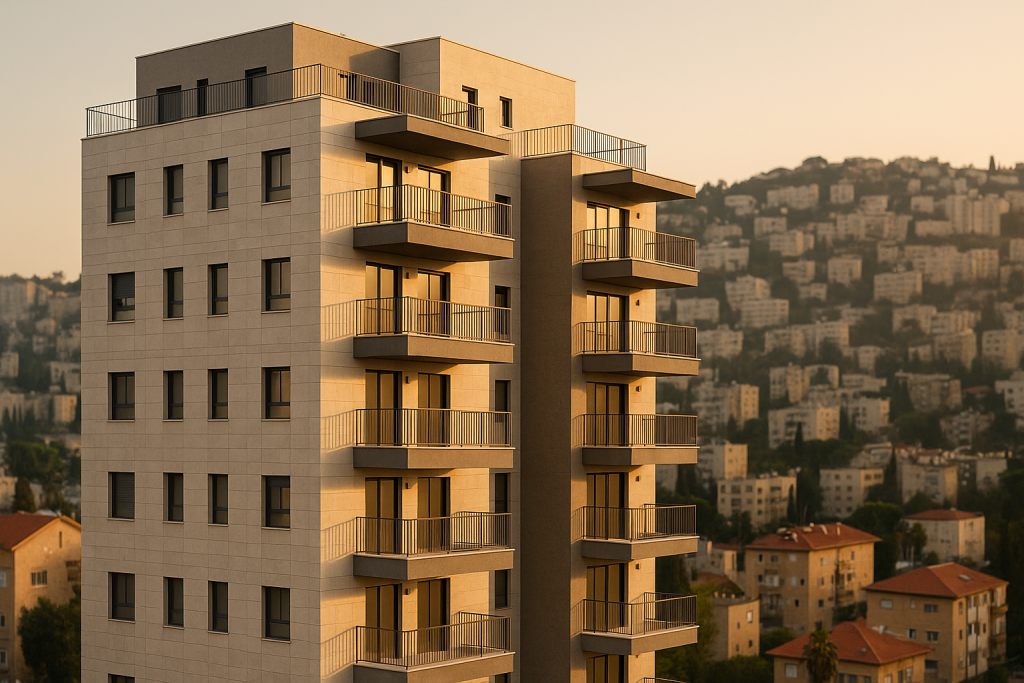
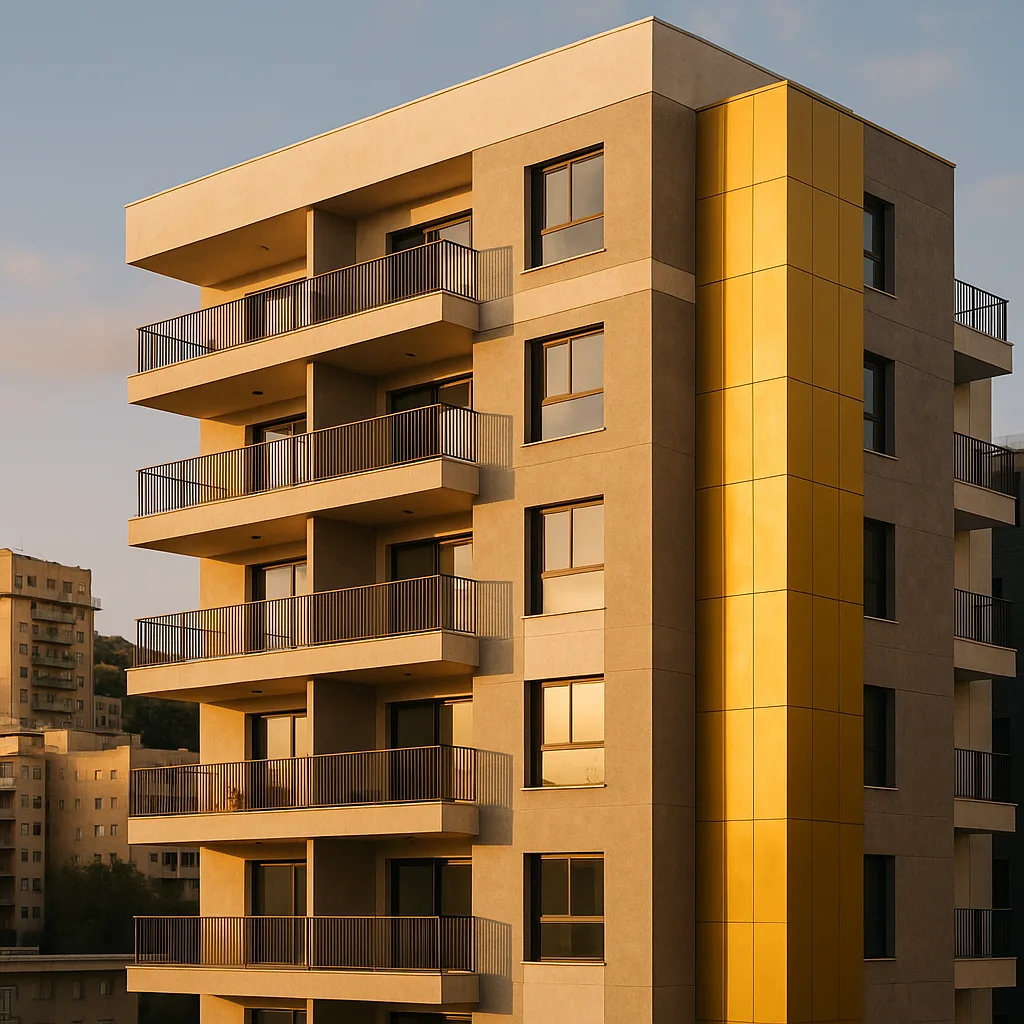
The Haifa real-estate market is undergoing a quiet revolution. While Tel Aviv is red-hot and apartment prices in the Gush Dan region rose 18% in 2025, Haifa still offers genuine investment opportunities with returns of 5-7% a year, twice what the bank pays. But the real challenge is not finding the right property, it is knowing how to finance it correctly. Financing real-estate investments in Haifa is a complex field that combines mortgages, equity, financial tracks and tax planning, and mistakes are costly. If you are weighing a real-estate investment in Haifa, and especially in the urban renewal projects that are reshaping the city, this guide will give you all the tools to make an informed financing decision in 2026. Sound financing is especially important in Pinui-Binui projects in Haifa.
✓ Key points
- Why Haifa? A snapshot of the 2026 real-estate market
- Financing tracks for real-estate investments in Haifa, every option on the table
- A mortgage for an investment apartment in Haifa, what the bank does not tell you
- The right mortgage mix for investment, how to structure the loan
Table of Contents
- Why Haifa? A snapshot of the 2026 market
- Financing tracks for real-estate investments in Haifa
- A mortgage for an investment apartment
- The right mortgage mix for investment
- Comparing banks
- The unique advantages of financing in Haifa
- Expected yield and return on investment
- Risk management
- Tax benefits
- Step by step: from decision to the key
- Frequently asked questions
Why Haifa? A snapshot of the 2026 real-estate market
Haifa is no longer the “forgotten city” of the Israeli real-estate market. Figures from the Central Bureau of Statistics and the Haifa Chamber of Commerce for 2025 show that apartment prices in the city rose 12.4%, above the national average of 9.8%. But what really interests investors is that Haifa is still at an attractive entry point: a 3-room apartment in Haifa costs 1.45 million shekels on average, compared with 2.9 million in Tel Aviv and 2.1 million in Jerusalem. That gap is not just a matter of price, it creates a built-in financial advantage in everything related to financing.
Looking at the Hadar neighborhood, which has been transformed over the past decade, you see apartments that sold for 450,000 shekels in 2015 now standing at 1.1 million, a 144% rise in value. In the French Carmel, 4-room apartments sell for 1.8-2.3 million shekels and yield rents of 5,500-7,000 shekels a month. The Ahuza neighborhood offers a double appeal: high rental demand from the professional workforce of the high-tech companies that have settled in the city, and expected appreciation thanks to the many Pinui-Binui projects in the area.
Here are the figures driving Haifa’s growth:
- Metro and light-rail infrastructure: Haifa’s new transport network includes a light rail costing 20 billion shekels that will connect all the neighborhoods, along with the deep-metro plan projected to generate 47,000 new apartments in the metropolitan area.
- Technology hubs: the headquarters of Salesforce Israel, Google Research, Amazon AWS, Intel Haifa and Microsoft are all located in Haifa and together create more than 12,000 high-tech jobs with an average salary of 28,000-42,000 shekels.
- Demographic shift: young people are returning to Haifa. 34% of buyers in 2025 were aged 25-35, and 22% of them were high-tech workers who had moved from Gush Dan.
- Urban renewal: 47 active building-renewal and Pinui-Binui projects in 2026 are completely changing the face of neighborhoods such as Hadar, Bat Galim and Ramat Almogi.
- Universities: the Technion and the University of Haifa bring in 27,000 students each year, steady rental demand that ensures high occupancy.
Financing tracks for real-estate investments in Haifa, every option on the table
Before you approach the bank, it is important to understand that financing real-estate investments in Haifa comes from several sources, each with clear advantages and disadvantages. The key to success is not to pick a single track but to combine sources of financing to maximize the return and minimize risk. A seasoned investor understands that every 0.5% in interest adds up to 15,000-30,000 shekels over the life of the loan, so this decision demands thorough research.
According to Bank of Israel data on the mortgage market, the volume of new mortgages reached 8.2 billion shekels a month in 2025, and the growth trend is continuing. Haifa accounts for about 11% of all national mortgages, with an 18% rise in demand for investment mortgages in the northern region.
| Financing track | Maximum financing rate | Annual interest range | Repayment range | Suitable for | Main advantage |
|---|---|---|---|---|---|
| Bank mortgage for a second home | 50% | 4.2-5.1% | 15-30 years | A first investment | Low interest, stability |
| Bridge loan | 70-80% | 6.5-8.5% | 6-24 months | A fast purchase before a sale | Timing flexibility |
| Non-bank financing | 60-75% | 7-12% | 1-10 years | Properties with valuation issues | Fast approval |
| Back-to-back loan | Up to 50% of the existing property’s value | 4.5-5.5% | 15-25 years | Owners of an existing property | Attractive interest |
| Investment partnership | 50-100% | Shared return | Per agreement | A shortage of equity | Entry without full capital |
| Real-estate investment trust (REIT) | 100% | 4-7% return | No limit | Passive investment | Risk diversification |
The right choice depends on your financial situation: if you have equity of 700,000+ shekels and comfortable monthly repayment capacity, a bank mortgage is the best choice. If you need to sell an existing property to fund the purchase, a bridge loan will let you buy without time pressure. And if you want to start with limited capital, a partnership with another investor can be the solution, as long as the agreement is properly drafted by a specialist lawyer.
A mortgage for an investment apartment in Haifa, what the bank does not tell you
Buying a second (investment) home is subject to the Bank of Israel’s strict rules: a maximum of 50% financing (LTV, loan to value). This means that on an apartment costing 1.45 million shekels, you will need equity of at least 725,000 shekels. But it does not end there, there are additional costs that beginner investors forget to factor in: purchase tax (8% on a second home = 116,000 shekels), lawyer’s fee (0.5-1.5% = 7,250-21,750 shekels), a surveyor (2,500-4,000 shekels), a mortgage adviser (3,000-5,000 shekels), life and building insurance (1,500-3,000 shekels a year). All in all, the capital required reaches 855,000-870,000 shekels.
The payment-to-income ratio (PTI) is a critical parameter. The Bank of Israel caps the monthly repayment at 40-50% of net disposable income. Different banks calculate this differently: some count 70% of the expected rental income as income, and others count only 50%. For example: if your net salary is 18,000 shekels and you have expected rental income of 4,800 shekels, a bank that counts 70% of the rent will see total income of 21,360 shekels and allow a repayment of up to 8,544 shekels. A bank that counts 50% will see income of 20,400 shekels and allow only 8,160 shekels. That small difference can determine whether you get the mortgage or not.
What the bank will not tell you on its own initiative: the mortgage interest rate is negotiable. Investors who bring pre-approvals from 3 different banks manage to lower the rate by 0.2-0.5% on average, a saving of 25,000-60,000 shekels over the life of the loan. It is advisable to arrive with an orderly financial file: three months of pay slips, a credit report, proof of existing assets, and a short business plan showing the expected return.
The right mortgage mix for investment, how to structure the loan
The mortgage mix is the most important financial decision after choosing the property itself. The wrong mix can cost you tens of thousands of unnecessary shekels, while a smart mix can turn an average investment into an excellent one. The central idea is risk diversification: not putting all your eggs in one basket, but spreading across different interest tracks so that part of the loan is always “protected” from market swings.
| Interest track | Current rate (2026) | Advantage | Disadvantage | Recommended share of the mix |
|---|---|---|---|---|
| Fixed unlinked | 5.2-5.6% | Full certainty, no surprises | Relatively high interest | 30-40% |
| Fixed index-linked | 4.7-5.1% | Lower interest | Exposure to inflation | 0-20% |
| Variable every 5 years | 4.1-4.5% | The lowest interest | Future uncertainty | 30-50% |
| Prime (P+margin) | 6.75-7.25% | Falls when the Bank of Israel cuts rates | The most expensive right now | 0-20% |
The recommended mix for 2026 for an investor: 35% fixed unlinked + 45% variable every 5 years + 20% prime. The logic: interest rates in Israel are trending down, the Bank of Israel has already cut the rate twice in 2025 and analysts’ forecasts point to a further cut of 0.5-0.75% by the end of 2026. Limited exposure to prime (which will fall) is therefore worthwhile, while the fixed unlinked portion protects against a scenario in which inflation returns and pushes rates up.
For investors planning to sell within 5-7 years, it is worth considering a more aggressive mix: 50% variable every 5 years + 30% prime + 20% fixed. On an apartment at 725,000 shekels (50% of 1.45 million), the difference in the monthly repayment between a conservative and an aggressive mix is about 350-500 shekels, or 4,200-6,000 shekels a year.
Comparing banks, where to take financing for real-estate investments in Haifa
The difference between one bank’s offer and another can add up to 80,000-150,000 shekels over the life of the loan. That is not an exaggeration, it is math. On a loan of 725,000 shekels over 20 years, a difference of 0.4% in interest is worth about 36,000 shekels. Add differences in fees, refinancing flexibility and approval times, and the gap swells. It is important to compare at least 3 banks, and preferably 4-5:
| Bank | Strength for investment | Mix flexibility | Approval speed | Average fixed-unlinked rate | Special advantage |
|---|---|---|---|---|---|
| Mizrahi Tefahot | Very high | Very high | 5-8 days | 5.15% | Market leader in mortgages, investment expertise |
| Bank Hapoalim | High | High | 7-10 days | 5.25% | Advanced digital service, an insurance wrapper |
| Bank Leumi | High | Medium | 10-14 days | 5.35% | Concessions for investors with an existing asset portfolio |
| Discount | Medium-high | Medium | 7-12 days | 5.30% | Aggressive on deals over 2 million |
| Bank Jerusalem | Medium | High | 5-7 days | 5.40% | The fastest approval, suited to urgent deals |
Golden tip: do not close a mortgage without an independent mortgage adviser. The cost of the advice (3,000-6,000 shekels) pays for itself 10-20 times over on average. A good adviser knows how to exploit the competition between banks and secure rates you would not get on your own. In addition, the adviser will check that the mix is tailored to your specific financial situation, and not just a “standard mix” that the banker offers everyone.
Pay attention to the matter of penalties too: some banks charge a high early-repayment penalty (up to 3%) on the fixed track. If there is a chance you will want to sell or refinance within 5-7 years, check that the contract allows early repayment at a reasonable cost.
The unique advantages of financing real estate in Haifa, what nobody tells you
Haifa offers financial advantages that simply do not exist in other Israeli cities, and smart investors know how to exploit them. Here are the main advantages that make Haifa the number-one city for real-estate financing in Israel in 2026:
Low entry prices = leverage on more properties: whereas in Tel Aviv the equity required for a single investment apartment is 1.5-2.5 million shekels, in Haifa the same capital is enough for 2-3 apartments. An investor with 1.5 million shekels can buy two apartments in Haifa (each at 1.5 million with 50% financing) and receive double the rental income, about 9,600-10,000 shekels a month versus 7,500 shekels from a single apartment in Tel Aviv.
Steady and varied rental demand: Haifa enjoys 27,000 students (Technion + university), 8,000+ lecturers and academic staff, 12,000+ high-tech workers, 6,000+ medical staff (Rambam + Carmel + Bnai Zion), and tourists to the Bahai Center. This diversity ensures that even if one sector weakens, there is always alternative demand.
Urban renewal = guaranteed appreciation: Pinui-Binui projects in Haifa have recorded gains of 35-55% between the start of the project and its completion. Investors who buy an apartment in a neighborhood with an approved Pinui-Binui project enjoy a “halo effect”, an appreciation of 15-25% even in nearby properties that are not part of the project. Neighborhoods such as Hadar HaCarmel, Bat Galim and Neve Sha’anan are in the midst of change, and prices are soaring.
Low maintenance costs: municipal tax in Haifa is 20-30% lower than in Tel Aviv, and an average building-committee fee stands at 250-400 shekels versus 500-800 in the center. On two apartments, the saving adds up to 6,000-10,000 shekels a year, money that goes straight into the net return.
Expected yield and return on investment, the full calculation with Haifa examples
Return on real estate is made up of two components: rental yield (monthly cash flow) and property appreciation (capital gain). Beginner investors look only at the rent, professional investors look at the full picture:
| Parameter | 2-room apartment in Hadar | 3-room apartment in Ahuza | 4-room apartment in Carmel |
|---|---|---|---|
| Purchase price | 850,000 shekels | 1,450,000 shekels | 2,100,000 shekels |
| Equity (50%) | 425,000 shekels | 725,000 shekels | 1,050,000 shekels |
| Related costs (purchase tax + fees) | ~78,000 shekels | ~130,000 shekels | ~184,000 shekels |
| Total investment | 503,000 shekels | 855,000 shekels | 1,234,000 shekels |
| Monthly rent | 3,200 shekels | 4,800 shekels | 6,800 shekels |
| Monthly mortgage repayment | 2,700 shekels | 4,600 shekels | 6,650 shekels |
| Net monthly cash flow | +500 shekels | +200 shekels | +150 shekels |
| Gross rental yield | 4.5% | 3.97% | 3.89% |
| Expected annual appreciation | 10-15% | 8-12% | 6-10% |
| Total ROI (first year) | 12-18% | 9.5-14% | 7.5-12% |
Note the paradox: cheaper apartments in developing neighborhoods (such as Hadar) produce a higher rental yield and higher appreciation, but also carry higher risk (tenant quality, maintenance). Expensive apartments in established neighborhoods (Carmel, Ahuza) offer stability and security, but a lower yield. The choice depends on your risk profile and on whether you are looking for ongoing cash flow or long-term appreciation.
Risk management, what can go wrong and how to protect yourself
Every investment carries risk, and real estate is no exception. The key is not to avoid risk but to manage it properly. Here are the main risks in real-estate financing in Haifa and how to deal with each of them:
Interest-rate risk: if the rate rises by 1%, the monthly repayment on a loan of 725,000 shekels will increase by about 450 shekels. The defense: no more than 20-25% of the mortgage in prime, with the rest in fixed tracks. Keep a safety cushion of at least 3 months of repayments.
Vacancy risk: a period without a tenant hits profitability directly. The average vacancy in Haifa: 2-4 weeks a year (below the national average). The defense: keep a reserve of 3 months of rent aside, and make sure the apartment is well maintained and suited to the local market (air conditioning, a balcony, parking).
Valuation risk: a lower-than-expected valuation can hurt the financing rate. The defense: carry out an independent private valuation before committing to the property. The cost (2,500-4,000 shekels) is insurance worth every shekel. Pay particular attention to older properties in Haifa, valuation gaps are common in properties from the 1960s-70s.
Regulatory risk: legislative changes can affect the case for the investment. For example: raising the purchase tax on a second home from 8% to 10% (as discussed in the Knesset) would add 29,000 shekels to the cost of an apartment at 1.45 million. The defense: legal and accounting advice before every deal, tracking legislation, and planning the holding structure (private vs. company) in advance.
Tenant risk: a tenant who does not pay or causes damage can turn a profitable investment into a loss. The defense: careful screening (pay slips, BDI credit checks, guarantors), a professional contract with a compensation clause, rent-loss insurance (80-120 shekels a month), and the use of a professional property-management company (5-8% of the rent) if you are not local.
Tax benefits in real-estate investments in Haifa, how to save tens of thousands of shekels
Sound tax planning can turn an average investment into an excellent one. Here are the main benefits every real-estate investor in Haifa must know, according to the Israel Tax Authority, real-estate taxation:
The reduced (10%) rental-tax track: instead of paying marginal tax (up to 50%), you can choose the 10% flat-tax track on rental income up to a ceiling of 5,654 shekels a month (as of 2026). On rent of 4,800 shekels, you will pay just 480 shekels in tax, a saving of 15,000-22,000 shekels a year compared with marginal tax. Note: under this track you cannot deduct expenses.
Annual depreciation deduction (2%): you can deduct 2% a year of the construction cost (not the land) as a depreciation expense. On an apartment at 1.45 million shekels (where the construction component is about 700,000 shekels), the annual depreciation is 14,000 shekels, a deduction that reduces the tax liability. Note: the depreciation is offset against the betterment tax on sale, so consult an accountant.
Holding through a limited company: from three properties and up, it is worth considering holding through a company. Corporate tax (23%) is lower than marginal tax (up to 50%), and you can deduct all the expenses: mortgage interest, repairs, lawyer’s fees, insurance, management. The saving on 3 apartments in Haifa: 35,000-55,000 shekels a year.
Spreading the betterment tax: on a sale at a profit, you can spread the betterment tax over 4 tax years, which lowers the effective tax rate. On a profit of 400,000 shekels, spreading can save 20,000-35,000 shekels.
Step by step: from decision to key in hand, the practical guide
The process of buying an investment apartment in Haifa takes on average 10-16 weeks from the moment of decision to receiving the key. Here are the practical steps, week by week, with precise costs and timelines:
- Weeks 1-2: setting a budget and a goal: decide on the total investment amount, decide on a goal (ongoing cash flow / appreciation / a combination), and choose a risk profile. An initial consultation with a real-estate investment adviser (some at no cost). Write down all your income and expenses, you will need this for the mortgage.
- Weeks 2-3: initial tax advice: a meeting with an accountant who specializes in real estate (cost: 1,000-2,000 shekels). The accountant will determine whether it is better to buy privately or through a company, and will plan the optimal deal structure from a tax perspective. This investment saves tens of thousands.
- Weeks 3-6: choosing a neighborhood and a property: tours of the main neighborhoods: Hadar (high yield, medium risk), Ahuza (stability, medium yield), French Carmel (premium, low risk), Neve Sha’anan (renewal, high potential), Bat Galim (tourism + investment). Check at least 10-15 properties before making a decision.
- Week 4: preparing the financial file for the mortgage: the last three months of pay slips, six months of bank statements, a personal BDI credit report, proof of existing assets/investments, a signed capital declaration.
- Weeks 5-6: pre-approval from at least 3 banks: submit applications to several banks in parallel. The pre-approval is valid for 45-90 days and lets you know exactly how much money you will receive and on what terms. Compare interest rates, mixes and fees.
- Weeks 6-8: due diligence: a certified surveyor (2,500-4,000 shekels), an engineer to check the building’s condition (1,500-3,000 shekels), a lawyer to check registration and liens, and checking building permits and future plans at the local authority.
- Weeks 8-10: signing the contract: negotiating the price (there is room in Haifa for a 5-8% discount on average), signing in the presence of your own lawyer (not the contractor’s/seller’s lawyer), paying a deposit (10-20%) and purchase tax within 50 days.
- Weeks 10-12: closing the mortgage: choosing the bank with the best offer, signing the mortgage documents, registering the lien.
- Weeks 12-16: completion and entry: transferring payments per the schedule, receiving the key, a light renovation if needed (15,000-40,000 shekels for a refresh), and marketing the apartment for rent.
Frequently asked questions about financing real-estate investments in Haifa
For a deeper dive, we also recommend our guide on income-producing properties in Haifa.
What is the minimum equity for an investment apartment in Haifa?
According to Bank of Israel guidelines, at least 50% self-financing is required. On an average 3-room apartment in Haifa (1.45 million shekels), the minimum equity is 725,000 shekels. Including related costs, the realistic total is 855,000-870,000 shekels. In cheaper neighborhoods such as Hadar or Kiryat Haim, you can start with 450,000-550,000 shekels.
Can I get an investment mortgage if I already have an existing mortgage?
Yes, absolutely. The bank checks the total payment-to-income ratio (PTI), which must not exceed 40-50% of net monthly income. Rental income from the new property (70% of it) is included in the income calculation.
What is the difference between a mortgage and a bridge loan?
Mortgage: a long term (15-30 years), interest of 4-5.5%, suited to a long-term investment. Bridge loan: a short term (6-24 months), interest of 6.5-9%, for those who need to buy before they sell. The higher interest can add up to 35,000-80,000 shekels over a one-year period.
Is urban renewal worth investing in from a financing standpoint?
TAMA 38 and Pinui-Binui projects in Haifa offer a purchase at a second-hand price and receipt of a new apartment. The banks treat this as a second-hand purchase (50% financing), but the value after the project is expected to rise by 35-55%. Note: there is no rent for 1.5-3 years during construction, so cash-flow planning is critical.
What are the most common mistakes in real-estate financing in Haifa?
Three main mistakes: (1) 68% of investors do not keep a cash reserve, the rule: 3-6 months of repayments as a reserve. (2) 54% do not compare banks, an average difference of 67,000 shekels over the life of the loan. (3) 41% do not consult an accountant before the purchase, saving on advice of 1,500 shekels that could save 50,000+ shekels in tax.
Ahuza Real Estate, experts in real-estate investments in Haifa and in urban renewal, TAMA 38 and Pinui-Binui. Guiding private investors, advising on projects and knowing the Haifa real-estate market inside out.
Last updated: April 2026 | Verified by the Ahuza Real Estate team
More articles you may find useful
Looking for smart financing for a real-estate investment in Haifa?
The Ahuza team guides investors through every stage of the process, from sourcing to handover.
Related Articles
- "NIS 30-40K in Summer": Dor Neuman on How Families Can Save This Year, in a Ynet Interview on the Cost of the Summer Holiday
- Purchase Tax on a First Apartment in Haifa 2026: Brackets, Exemptions and Savings
- Radio Interview on "Nadlanist": Why Investors Still Ask About Wild Boars and Pollution in Haifa
- Real Estate Expert Dor Neuman on Channel 14 Urges Young People to Get a Foot in the Door – Even If It Is Far from the Center