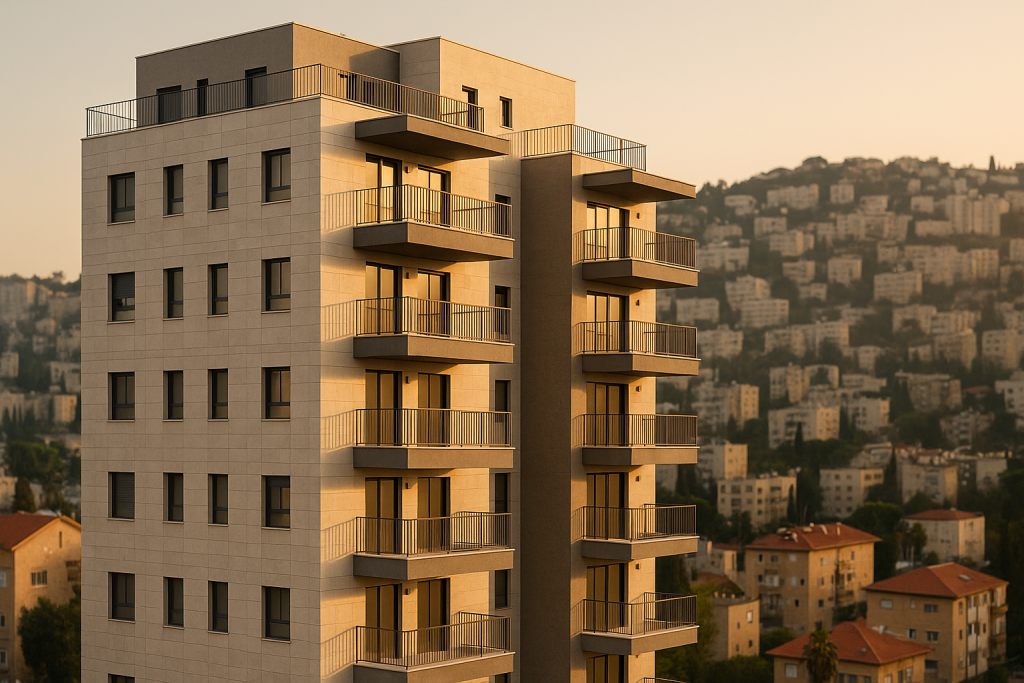
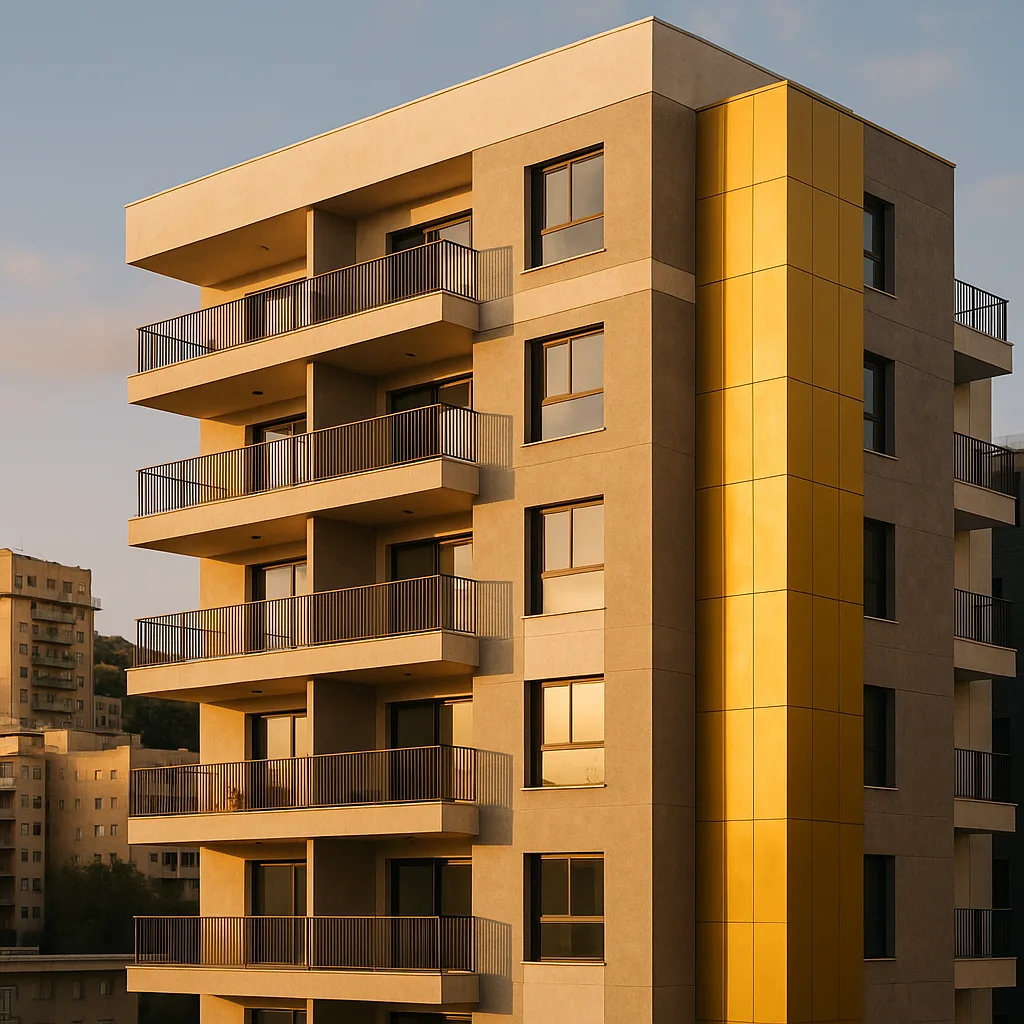
Evacuation-Construction (Pinui-Binui) in Haifa 2026 has become the central growth engine of the city’s real estate market. In 2026 the Haifa Municipality approved more than 12 active evacuation-construction projects, encompassing thousands of new housing units. If you own an apartment in an older building in one of Haifa’s veteran neighborhoods, Kiryat Haim, Neve Sha’anan, Ramot Remez, Kiryat Shmuel or Hadar, there is a good chance you will face a major decision within the next year or two. This guide gives you a clear picture: what evacuation-construction is, what you are entitled to as a resident, which neighborhoods have active projects right now, and the practical stages you will need to go through.
Evacuation-construction is one track within a broader picture, and it is worth viewing it alongside the other tracks of urban renewal in Haifa.
What is Evacuation-Construction and how does it work in Haifa?
Evacuation-construction is an urban renewal track in which the residents of a compound of old buildings vacate their apartments, the buildings are demolished, and a new compound with far more housing units is built in their place. The original residents receive brand-new apartments in the new compound, usually larger and better than their original ones, at no cost, while the developer finances the entire project from the surplus apartments it sells on the open market.
In Haifa, the process is carried out under the framework of the 2026 municipal master plan, which designates priority zones for evacuation-construction in the veteran neighborhoods that contain buildings from before 1980. Unlike TAMA 38, which is carried out on a single building, evacuation-construction requires the consent of a decisive majority of all residents in the compound, usually at least 80%, and demands a longer planning process. In return, the scope of rights that residents receive under evacuation-construction is significantly greater.
In 2026, Haifa’s municipal priority is given to compounds of at least 24 housing units in areas with existing public-transport infrastructure. The Ministry of Construction and Housing approved a special budget of 240 million shekels to fund the planning of projects in cities designated as national priorities, with Haifa at the top of the list.
What do residents receive in a Haifa evacuation-construction project?
The first question every resident asks is: what do I actually get? The short answer: a new, larger apartment in the same compound, at zero cost. But the package includes much more than that.
Added floor space: In Haifa’s evacuation-construction projects in 2026, the standard addition is 25 net square meters per existing apartment. A 70 sqm apartment becomes a 95 sqm apartment with a sun balcony, additional bathrooms and an attached storage unit.
Dedicated parking and storage: Every apartment receives a dedicated parking space in the new underground garage, sometimes two, as well as a 5–8 sqm storage unit. In the old buildings of Neve Sha’anan or Hadar, most residents currently have no parking at all, so this is a dramatic change in quality of life.
Alternative rental period: During construction, the developer pays full rent for an alternative apartment in the area, for an average of 30–36 months, including moving costs.
Bank guarantees: Residents receive a full bank guarantee for the value of the alternative apartment, a guarantee for meeting the schedule, and a performance guarantee. These are the strongest safeguards in the Israeli real estate market.
Added economic value: An average apartment in Neve Sha’anan in 2026 is worth about 1.85 million shekels. The new apartment in the renewed compound is usually worth 2.6–2.9 million shekels, a net value increase of a million shekels or more, at no expense to the resident. Investment apartment in Haifa 2026 includes a full analysis of price trends in these neighborhoods.
Haifa neighborhoods with active evacuation-construction projects in 2026
Not every neighborhood in Haifa is included in evacuation-construction projects. In 2026, five neighborhoods lead the process, each with unique characteristics that affect the terms of the deal.
Kiryat Haim, leading in project scope
Kiryat Haim leads Haifa’s evacuation-construction volume in 2026 with 4 approved compounds totaling 1,840 housing units. The old 3–4 story buildings from the 1950s–60s are being cleared, replaced by 14–18 story towers. Kiryat Haim residents enjoy proximity to the seafront, to the Haifa West train station, and to the new shopping center that opened in 2025.
Neve Sha’anan, a sought-after area with high additions
Neve Sha’anan has become the most sought-after neighborhood for evacuation-construction in Haifa. Its proximity to the Technion, the red and blue Metronit lines, and its high rate of apartment turnover make the area a developer’s gold mine. In Neve Sha’anan in 2026, 3 compounds with roughly 960 housing units are active. The average floor-space addition per resident stands at 28 sqm, among the highest in the city. Investment neighborhoods in Haifa 2026 includes an in-depth analysis of Neve Sha’anan.
Ramot Remez, large compounds, approval expected in 2027
Ramot Remez holds enormous evacuation-construction potential thanks to its expansive land plots and its veteran construction. In 2026 two compounds are in advanced zoning-plan stages, with actual evacuation approval expected in 2027. Residents who begin signing agreements now will enjoy improved terms, an addition of up to 30 sqm and two dedicated parking spaces in some agreements.
Kiryat Shmuel, a partnership with a veteran construction company
Kiryat Shmuel is an interesting example of medium-scale evacuation-construction. A compound of 320 units is under construction, the first in Kiryat Shmuel, led by a well-known construction company. Expected occupancy: end of 2028. The current residents enjoy alternative rent nearby in Kiryat Motzkin or Neve Yosef.
Hadar, a historic area with planning challenges
Hadar is an area with great evacuation-construction potential, but also challenges: some of the buildings have architectural conservation value, which complicates planning. In 2026 one large compound of 540 housing units is active in the Upper Hadar area. Proceedings are expected to accelerate in 2027–2028 with the approval of the Haifa Municipality’s strategic plan. Urban renewal in Haifa 2026 presents a full map of all the renewal areas.
How does the evacuation-construction process work? Step by step
The process looks long, but it can be divided into clear stages. Understanding the stages allows residents to know when to expect each milestone and how to prepare for it.
Stage 1, the developer approaches the residents (months 0–3): A construction company identifies a potential compound and approaches the building committee or leading residents. At this stage an initial memorandum of understanding is signed, allowing the developer to begin preliminary planning work.
Stage 2, planning checks (months 3–9): The developer conducts feasibility checks, is the compound planning-suitable, what scope of rights can be obtained, is the project economically worthwhile. At the end of this stage, residents receive an initial commercial offer.
Stage 3, signing agreements (months 9–15): Each resident signs an evacuation-construction agreement. At least 80% of signatures are required. The complete guide to real estate in Haifa explains every essential clause of the contract. At this stage it is vital to have legal counsel from a lawyer acting on behalf of the residents, never the developer’s lawyer.
Stage 4, zoning plan and approvals (months 15–36): The developer submits a city building plan to the local committee. This is the longest stage. The Ministry of the Interior approves the zoning plan at the district level, after which a building permit can be issued.
Stage 5, evacuation and excavation (months 36–42): Residents vacate their apartments and move to alternative apartments. The developer demolishes the old buildings and begins excavating the basement.
Stage 6, construction and occupancy (months 42–72): Construction of 30–36 months, then occupancy. Residents return to the new compound and their new apartments.
Evacuation-Construction versus TAMA 38, a full comparison
Both tracks are considered urban renewal, but the differences between them are substantial. The table below summarizes the main differences a resident should be aware of before deciding. Note that TAMA 38 itself expired in October 2023, and the TAMA 38 column describes the single-building track, which today is advanced as a detailed plan at the local committee (the Shaked Alternative, single-building renewal).
| Parameter | Evacuation-Construction | TAMA 38 |
|---|---|---|
| Scope | A compound of several buildings | A single building |
| Required consent rate | 80% of residents | 66% (strengthening and addition) or 80% (demolition and rebuild) |
| Floor-space addition per apartment | 25–30 sqm | 12–25 sqm |
| Vacating the apartment | Mandatory, alternative apartment during construction | Not necessarily (in the strengthening-and-addition track) |
| Project duration | 5–7 years | 2–4 years |
| Value added to the apartment | ₪800,000–₪1,200,000 | ₪300,000–₪600,000 |
| Parking | Mandatory, usually 1–2 dedicated spaces | Not always (depends on the plot) |
In short: evacuation-construction is large, slow and delivers a high value increase. TAMA 38 is small, faster and delivers a lower value increase. The choice between the two depends on the condition of the building, the size of the compound, and the residents’ wishes. In the Haifa urban renewal guide 2026 you will find further in-depth analysis.
Questions and answers about evacuation-construction in Haifa
How long does an evacuation-construction project in Haifa take from start to finish?
An evacuation-construction project in Haifa takes an average of 5–7 years from the moment the first agreement is signed until the new apartments are handed over. The longest stage is the zoning-plan proceedings, usually 18–24 months. The construction stage itself takes another 30–36 months. Residents in Kiryat Haim who signed in 2021 are receiving their new apartments during 2026–2027.
Can I object to an evacuation-construction project in my compound?
Absolutely. Every resident is entitled to refuse to sign an evacuation-construction agreement. However, if 80% of residents agree, an application can be made to the Land Registrar, who can compel refusing residents, but only in exceptional cases where the resident is not receiving fair compensation. If you have substantive objections (for example an unfair offer), it is vital to obtain prompt legal advice.
What happens to the rent payments if the alternative apartment is more expensive than the compensation I receive?
In every evacuation-construction agreement in Haifa in 2026, the developer undertakes to cover the full rent for an alternative apartment of a size and standard similar to the original apartment, in a reasonable area. If you choose a more expensive apartment, the difference is paid by you. If you choose a cheaper apartment, the difference stays in your pocket, the agreements do not allow the developer to demand a refund.
Is there betterment tax on the new apartment I receive in evacuation-construction?
The Real Estate Taxation Law grants a full exemption from betterment tax to residents in evacuation-construction projects, even if the value of the new apartment is 50% or more higher than the old one. The exemption applies to a first apartment under the law. If this is a second apartment or more, you should consult a specialized accountant. The guide to real estate financing in Haifa explains the financial issues in detail.
What happens if the developer goes bankrupt in the middle of the project?
This is the greatest risk, which is exactly why the bank guarantees are critical. In every evacuation-construction project in Haifa, the developer is required to deposit a Sale Law guarantee for the full value of the new apartment, a rental guarantee for the entire construction period, and an additional performance guarantee. If the developer goes bankrupt, the bank steps into its shoes and completes the project, or returns the funds.
Can a tenant benefit from an evacuation-construction project?
No. Only apartment owners registered in the Land Registry are entitled to compensation in an evacuation-construction project. Tenants will receive notice to vacate the apartment as part of the project, but will not be entitled to an alternative apartment or any compensation. If you are renting, it is important to check your lease and your rights vis-à-vis the apartment owner.
Ahuza Real Estate has been guiding residents through evacuation-construction projects in Haifa for over a decade, from the developer’s first approach to receiving the key to the new apartment. The experience we have accumulated across hundreds of projects in Kiryat Haim, Neve Sha’anan, Ramot Remez and Haifa’s other neighborhoods allows us to accompany you at every stage, protect your interests against the developer, and make sure you come out of the deal with the best possible terms.
How long does a Haifa evacuation-construction project last, and what determines the pace of progress
One of the central questions Haifa residents ask is how long it will take until they receive the new apartment. The honest answer is that an average evacuation-construction project in Haifa lasts between seven and eleven years from the residents’ initial organization until the handover of the keys, with the planning stage before the local committee and the compound-planning committee accounting for about half of the timeline. It is important to understand the breakdown of the stages in order to plan correctly and not be disappointed by a pace that appears slow at the start.
The organization and resident-signing stage
In the first stage, a majority of eighty percent of the apartment owners in the compound is required to advance the project. In Haifa, due to the abundance of old jointly owned buildings in neighborhoods such as Hadar and Kiryat Haim, this stage alone usually lasts between one and two years. Common delays stem from refusing residents, from unregistered ownership in the Land Registry, and from disputes over the value of the existing apartments. It is advisable to appoint an orderly resident representation and to enlist a lawyer on behalf of the residents already at this stage.
The planning and statutory-approval stage
After selecting the developer and signing the agreement, the planning stage begins, in which a detailed plan is submitted to the Haifa local committee for planning and construction. This stage includes depositing the plan, hearing objections and final approval, and usually lasts between three and five years. In recent years the Haifa Municipality has advanced acceleration mechanisms for projects in large compounds, but the timelines still depend on the committee’s workload and on the topographical complexity of the neighborhood. In Haifa’s hillside areas, additional ground-stability tests are sometimes required, which extend the process.
The construction and handover stage
After receiving the building permit, residents vacate their apartments, receive monthly rent for the construction period, and move to alternative housing. Construction of an evacuation-construction compound in Haifa usually lasts between two and three years, depending on the number of buildings and their height. It is important to make sure the agreement stipulates that the rent is index-linked and that there is a binding schedule with agreed compensation for every month of delay in handover.
The safeguards, taxation and financial aspects every resident must know
Evacuation-construction is not a deal in which the resident pays money, but it is a deal in which the family’s main residence is put on the line. Therefore the system of safeguards and the tax aspect are the central touchstones for every resident in Haifa, not just the size of the new apartment. Understanding these components in advance prevents the most costly mistakes in the process.
Sale Law guarantees and additional safeguards
The developer is obligated to provide residents with a Sale Law guarantee that secures completion of construction, alongside a registration guarantee to secure the registration of rights in the Land Registry, and a rental guarantee that secures payment of the alternative housing throughout the entire construction period. Without these three guarantees, do not sign the agreement. In Haifa projects it is also advisable to check for a defects guarantee for repairing faults discovered in the first years after occupancy, since it protects the resident against unforeseen costs.
Tax exemptions and taxation aspects for residents
One of the significant advantages of evacuation-construction is the basket of tax exemptions the legislator granted to residents. An apartment owner who receives a new apartment as part of the project is usually entitled to an exemption from betterment tax and an exemption from betterment levy on the addition received, subject to the ceilings set in the law. That said, there are cases in which certain components of the deal are indeed taxable, so it is important to consult a tax adviser before signing. We expanded on this topic in the dedicated guide on urban renewal taxation in Haifa, which details all the aspects.
Ancillary costs that residents tend to forget
Although the deal involves no direct payment, there are ancillary costs worth budgeting for in advance. Among them: the fee of the residents’ lawyer, which is usually paid by the developer but is conditional on scope; the costs of moving to alternative housing and back; and sometimes higher management and maintenance fees in the new building, which includes elevators, a lobby and shared systems. Early budget planning prevents surprises down the road.
Seven common mistakes made by Haifa residents and how to avoid them
The experience of the Ahuza team in guiding residents through projects in Haifa teaches that most problems do not stem from the developer but from poor preparation by the residents themselves. We have gathered the recurring mistakes so you can avoid them in advance and preserve your full rights.
Signing too early and choosing a developer without vetting
The most common mistake is signing an agreement with the first developer who knocks on the door, without comparing several offers and without checking its financial soundness and prior experience. Residents who rush to sign sometimes give up significant addition percentages. It is advisable to examine at least three offers and to check previous projects the developer has actually completed. We gathered the full criteria in the guide how to choose a developer for urban renewal in Haifa.
The absence of an independent lawyer for the residents
Many residents rely on the developer’s lawyer or on a party the developer recommends, thereby giving up independent protection. A lawyer acting solely on behalf of the residents, chosen by the representation and representing only them, is essential. Their fee is usually built into the deal, so there is no reason to give up separate and independent representation.
Neglecting the representation committee and disorganized conduct
A weak or divided resident representation is a recipe for delays and for eroding bargaining power against the developer. It is important to choose a representative body, to document every decision in writing, and to maintain transparent communication with all apartment owners in the compound. In cases of internal dispute, external professional guidance helps preserve unity and prevent gridlock. For those interested in delving deeper into the rights and the legal stages, we recommend reviewing our expanded guide on Pinui-Binui in Haifa for residents.
Last updated: May 2026
Looking for an apartment in Haifa or in an urban renewal process?
The Ahuza team accompanies you through the entire process, from the search to the handover of the key