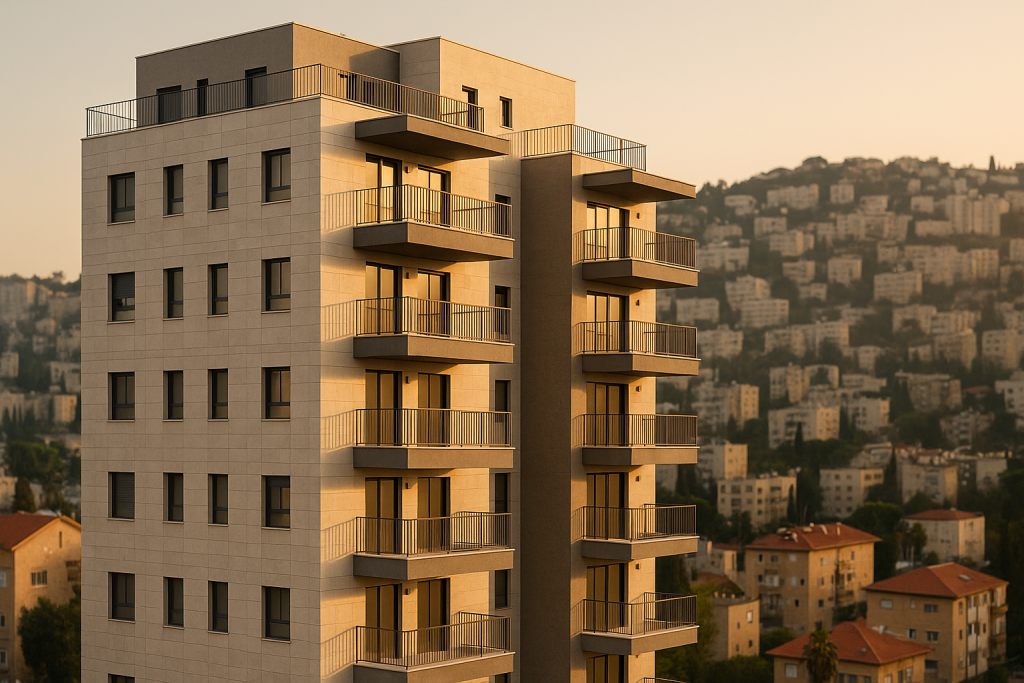
Income-generating investment in Haifa has become in recent years one of the most compelling investment avenues in Israel, combining a favorable entry point relative to the property price, developing transport infrastructure, and appreciation that is hard to find in central cities. Experienced real estate investors point to Haifa as the best income-property market in Israel for 2026, thanks to a combination of low entry prices, rental yields reaching up to 4.8% per year in most neighborhoods, and expected value appreciation of 6%–9% per year in urban renewal tracks. This is not merely a forecast, it is the result of data analysis. In this complete guide you will learn exactly how to build the best income-generating investment in Haifa for you, which neighborhoods lead today, how to finance it, and the precise calculation of your expected return.
Guide contents
- What is an income-generating investment, and why Haifa in particular
- Average yield in Haifa 2026, from rent and capital
- The leading neighborhoods for income investment in Haifa
- Calculating real ROI
- Financing the purchase, the key to yield
- Taxation and benefits for real estate investors
- Risks and common mistakes
- Frequently asked questions
Facts that make the difference, income investment in Haifa
- 4.8%: annual rise in apartment prices in Haifa (CBS), higher than the national average (3.2%)
- ₪3,600–₪5,800: monthly rent for a 3-room apartment in central neighborhoods (Carmel, Ahuza, Hadar)
- 6%–9%: value appreciation in the urban renewal track (TAMA 38 and evacuation-construction) within 4–7 years
- Annual yield: between 3.2% and 4.5% in the renewing neighborhoods, compared with 2.4%–2.8% in Tel Aviv
- 2026: the start of implementation of the Haifa 2030 master plan, an opportunity to enter early
What is an income-generating investment, and why Haifa in particular
An income-generating investment is the purchase of an asset that produces a steady, recurring cash flow, usually from rent or from commercial lease payments. Unlike a speculative investment, which relies only on possible value appreciation, an income investment provides a living monthly cash flow even before the profit is realized. The savvy investor does not rely on a guess alone; they buy an asset that pays them every month.
Haifa has become, in recent years, a magnet for income investment in Israel, for two complementary reasons: far lower entry prices, a 3-room apartment in a good Haifa neighborhood costs ₪1.4–₪2.1 million compared with ₪2.8–₪4.5 million in Tel Aviv; extensive urban renewal with TAMA 38 and evacuation-construction; a constant academic community that ensures rental demand; and infrastructure moves that shorten distances, the Metronit to the Kirya, the Carmel coast road, expansion of the metro network and an infrastructure upgrade toward 2030.
Average yield in Haifa 2026, from rent and capital
The average yield from an income investment in Haifa splits into two components: current yield from rent and capital yield, the appreciation in the asset’s value. According to CBS figures and the latest market surveys, the average rental yield in Haifa stands at 3.2%–4.5% per year, materially higher than Tel Aviv (2.4%) and Herzliya (2.6%). The reason is simple: apartment prices in Haifa are 25%–40% lower than in Tel Aviv and Herzliya, but rents are only 15%–20% lower, which creates a higher yield.
Appreciation in Haifa is supported by four engines: the “Haifa 2030” master plan, a comprehensive urban plan that increases building rights; the expansion of Haifa Port and the establishment of the logistics center that attract employers and workers; the growth of the “Matam” technology park that has drawn high-salaried engineers; the ongoing Technion 2.0 bringing in international students who increase demand for quality housing; and the various urban renewal plans that will create some 3,400 new housing units in the coming years in central neighborhoods such as Hadar, Neve Sha’anan and Kiryat Eliezer. This accumulation of demand engines makes an income investment in Haifa especially attractive, compared with Tel Aviv where entry prices are not significantly high relative to the asset’s value.
The leading neighborhoods for income investment in Haifa
Choosing the neighborhood is the most important decision in the income-investment journey in Haifa. Each neighborhood presents a different yield mix, tax benefits and appreciation potential. Below we go over the leading neighborhoods and which investor suits each one.
French Carmel, the classic luxury
Neighborhoods such as French Carmel, Ramat HaTishbi and Denya offer a value-preservation image with high rents, ₪4,800–₪6,500 for a renovated 4-room apartment. Benefits: sought-after location, clean tenants, low tenant turnover. The downside: high asset prices (apartments start at ₪2.3 million), which lowers the yield to 3.2%–3.6%.
Neve Sha’anan and Hadar, high yield in an emerging surge
Solid neighborhoods that have undergone significant transformation. Prices are 30% lower than the Carmel (₪1.6–₪2.0 million for a 3-room apartment), rents are relatively high (₪3,800–₪4,800), and the yield reaches 4.2%–4.8%. The potential continues thanks to the urban renewal taking place in the area, with a projected 25%–35% rise in asset value within 5–7 years.
Lower Hadar, low entry prices, TAMA 38 potential
Lower Hadar has become one of the hottest neighborhoods in Haifa for experienced investors. Prices of old apartments requiring renovation (building renewal, evacuation-construction) start at ₪1.4 million, and once complete the value jumps to ₪2.1–₪2.5 million, with no additional investment from the investor. This is the strongest path to a leveraged yield, combining current rent during the interim period with a jump in value at the end of the process.
Calculating real ROI, the formula professional investors use
A true income investment requires a calculation that goes beyond rent minus mortgage, to net yield and gross return on equity (Cash on Cash Return). The professional investor factors in building fees, municipal tax and insurance, vacancy periods, ongoing maintenance, tax, and management fees.
Sample calculator: a 3-room apartment in central Carmel
- Purchase price: ₪2,250,000
- Equity payment (25% + taxes and costs): ₪650,000
- Mortgage: ₪1,600,000 at 5.1% interest over 25 years → monthly repayment ₪9,250
- Monthly rent: ₪5,400
- Ongoing monthly expenses (building fees, municipal tax, maintenance, 8% vacancy): ₪1,150
- Net monthly cash flow: ₪4,250
- Cash on Cash Return: 7.85% per year: before asset appreciation
Add to that an average annual appreciation of 4.2% in the Carmel and you get a total return of 9%–10% per year, a worthwhile result that deposits and provident funds find much harder to reach.
Financing the purchase, the key to high yield
Smart financing is the factor that multiplies returns in an income investment. In the market at the start of 2026, interest stands at 5.0%–5.4% for a fixed track over 25 years, but sophisticated investors know that the necessary mortgage (LTV up to 75% for investors, up to 50% for home-upgraders) is only part of the picture. Non-bank financing, bridging loans and mezzanine loans complete the picture and allow more flexible leverage in complex investments.
For the perfect financing plan, one that will secure maximum yield and minimize risk, we recommend reading our financing guide for real estate investment in Haifa, which serves as an architecture guide for the optimal financing structure for real estate investments in Haifa.
Taxation and benefits for real estate investors
The Israeli tax system grants real estate investors several direct tax benefits. For a first apartment, a graduated tax bracket starts at 8% and rises with the apartment’s purchase price, while building-renewal and evacuation-construction transactions are fully exempt. Practically, a second apartment purchased for investment will be taxed at a graduated purchase-tax rate. It is also important to factor in the ongoing cash-flow impact of municipal tax and to plan around your marginal tax rate. In every case, a properly structured deal makes a real difference of several percentage points.
Practical recommendations: use a qualified real estate tax adviser before buying, the fee paid to the adviser typically pays for itself within a year. For example, planning around betterment tax when selling a second apartment within 5 years, rolling profits within a full tax framework, and flexible planning for the transfer of wealth between generations.
Risks and common mistakes to avoid
Not every investment in Haifa is income-generating; it depends on the data, the guidance and the location. The common mistakes that trip investors up:
- Buying by price alone: a low price does not always equal a suitable yield. Check the rents actually achieved in the specific neighborhood and match the price to the appropriate value.
- Work only with documents: purchase agreement, appraiser’s report, Land Registry extract, the building’s file, a lien check and a 10-year maintenance plan, all in writing.
- Excessive leverage, a financial sword: a mortgage above 75% LTV for investors increases risk. The picture: if the market drops 5%–10%, the investment turns negative, and the mortgage may demand immediate repayment.
- Ignoring the local rental market: who are the tenants in this neighborhood? What are the vacancy rates? What are the statistics on real rents in the local market?
- Not accounting for betterment tax: many investors neglect to plan for betterment tax and discover that a profitable investment turns into a tax loss.
Frequently asked questions, income investment in Haifa
What is a reasonable yield from an income investment in Haifa?
What is the minimum equity for a first income investment?
Is it worth investing in TAMA 38 or evacuation-construction?
Which neighborhoods are most recommended for income investment in Haifa?
What is the “Haifa 2030” plan and how does it affect investment?
How long does it take to see a positive ROI from an income investment?
Is it better to invest through a real estate fund or directly in an apartment?
Looking for an income investment in Haifa? We are with you
The Ahuza team accompanies real estate investors in Haifa from locating the right asset, through financing, to the first cash flow. An introductory phone call with us is free and with no obligation.
To dive deeper into these topics: urban renewal in Haifa, evacuation-construction in Haifa, and also investment apartments in Haifa.